How Do You Know Which Conversion Factor to Use
The energy density of the buckwheat as 6664 BTUlb 155 x 429922. When we use conversion factors to convert units we will multiply our original measurement by the conversion factor to get the same.
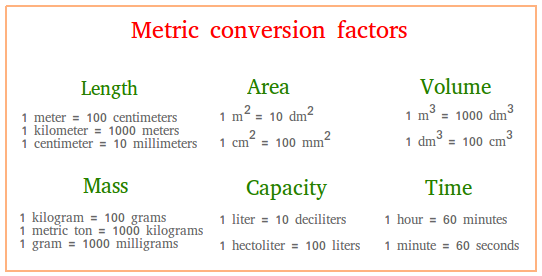
Metric Conversion Factors
Change 3 hours and 36 minutes to the same units.
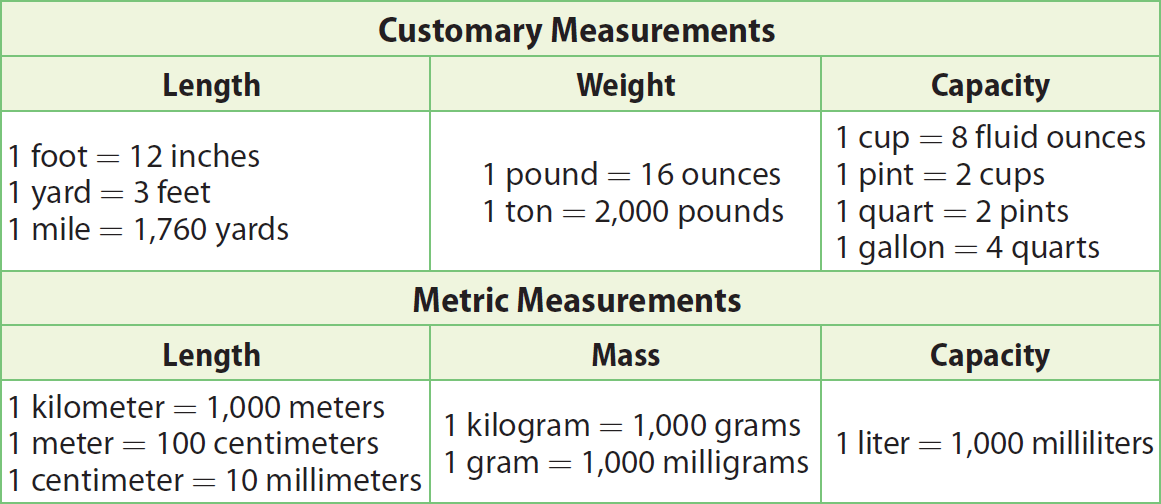
. The conversion factor will be a ratio or fraction. Conversion factors are just math quantities that you use to convert one unit into a different oneWhats the. Next we use one of our equivalence statements to make the conversion factor that will allow us to cancel out days 2 days 24 hours 1 day.
1 kg 1000 g is your conversion factor. One foot is 12 inches long and the conversion factor of 1 foot to inches is 12. A conversion factor is a number used to change one set of units to another by multiplying or dividing.
The cube of 1 is 1 the cube of 3 is 27 and the units of length will be cubed to be units of volume Using these facts I get. Thats two words you know. 1 hour 60 minutes.
Figure out the units you want. If you know that there are 3048 feet in a meter then you can use that as a conversion factor to determine what the same distance is in meters. The appropriate conversion factor is.
If you use that number it has infinite precision. Also to know is what are conversion factors used for. Such a tool can help you determine the amount of coverage needed based on the current speed of your vehicle as well as the average rate for a round trip journey.
Steps for Unit Conversions Look at the units you have. Using minutes is easier because the end time value will need to be in seconds. You would set up the conversion factor like this 25 g 1kg 1000g 0025 kg This can be read as.
When a conversion is necessary the appropriate conversion factor to an equal value must be usedFor example to convert inches to feet the appropriate conversion value is 12 inches equal 1 foot. We have described conversion factors as fractions equaling 1. Conversion factors are usually set up as ratios that allow for easier conversions between units.
For example if you know that there are 254 centimeters in every inch or 22 pounds in every kilogram or 1013 kilopascals in every atmosphere then converting between those units becomes simple algebra. You can do this as many times as you want. Click to see full answer.
Video Source 0434 mins Transcript. Go to the category of Energy Density in Table 1 and find the column for MJkg. Locate the numeral 1 under that column and then read to the left to get the multiplication factor of 429922 under the BTUpound column.
It will have the unit we want - meters in this case - in the numerator top and the unit we have - feet - in the denominator bottom. If youre not sure about that cubic-yards and cubic-feet equivalence then use the fact that one yard equals three feet and then cube everything. Molarity is an example of a conversion factor.
Eromod The conversion factor is only exact if you use that exact conversion factor. We all know from elementary school math that if you multiply any quantity by 1 you get the same quantity back. So lets say you need to convert 25 g to kg.
Sep 15 2016 at 327. This is so that the old units will cancel out leaving us with the new units. For example 21 2 and 18111 18.
For example if the molarity is. 1 day 24 hours 1 hour 60 minutes First we start with what we have which is two days. Now we need to assign numbers to the question marks in the conversion factor.
05 mol1 L or 1 L05 mol. The conversion ratios are 1 wheelbarrow 6 ft3 and 1 yd3 27 ft3. This unit can be hours or minutes.
In yards 1 foot is equal to 13 yard conversion factor of 1 foot to yards is 13 so forth. We can use the following equivalence statements to make our conversion factors. The easiest way to find out the conversion factor is to use a mileage calculator that is easy to use and understand.
How do you use Conversion Factors. You can use whichever one gives you the correct units for the answer because each conversion factor equals 1. 05 molL the conversion factor is either.
25g times 1 kg for every 1000 g equals 0025 kg. Find the conversion factors that will help you step by step get to the units you want. The following video will show an example of using two conversion factors.
Arrange conversion factors so that unwanted units cancel out. Multiplication by 1 is what you do whenever you do a problem involving conversion factors. A conversion factor uses your knowledge of the relationships between units to convert from one unit to another.
3 hours and 36 minutes 180 minutes plus 36 minutes 216 minutes Step 2. For example an inch is defined as 254 cm. However if you say ahh 25 is close enough then the conversion factor only has 2 significant digits.
Using Conversion Factors To Solve Problems

Useful Conversion Factors And Relationships Chemistry Education Conversion Factors College Chemistry

Conversion Factors Chemistry Lesson
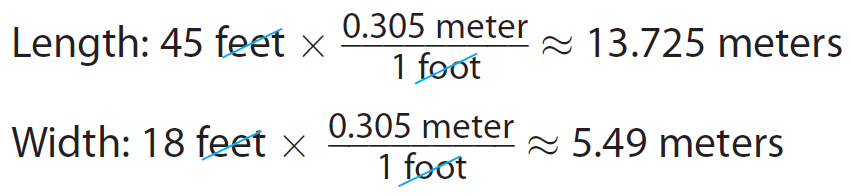
Using Conversion Factors To Solve Problems


Comments
Post a Comment